Showing posts with label P. Show all posts

Product Costing


Costing is a process by which to set a price of a product is calculated by considering all the related factors. Doing Cost Analysis is a very important task for a factory which runs for business purposes. Costing of the products considering the raw material expenditure, salary of officers and workers, distributions and advertisement expenses etc. all direct and indirect expenses is considered very honestly. It is determined by a troop of accountants with advice and consultancy of executive director.

Methods of Increasing Production (Knitting)

From the following methods we can increase the production of knitting. The methods are,
1. By increasing machine speed: Higher the machine speed faster the movement of needle and ultimately production will be increased. But it has to make sure that excess tension is not imposed on yarn because of this high speed. 
2. By increasing the number of feeder: If the number of feeder is increased in the circumference of cylinder, then the number of courses will be increased in one revolution at a time. 
3. By using machine of higher gauge: The more the machine gauge, the more the production is. So by using machine of hgier gauge production can be increased.
4. By imposing automation in the machine
a. Quick starting and stopping for efficient driving system.
b. Automatic machine lubrication system for smoother operation.
c. Photo electric fabric fault detector.
5. By imposing other developments:
a. Using creel-feeding system.
b. Applying yarn supply through plastic tube that eliminates the possibilities of yarn damage.
c. Using yarn feed control device.

Effluent Treatment Plant

To save environment, Effluent Treatment Plant used in Textile Industry. Different Section of Textile Manufacturing unit passes huge pollutants water which is very harmful for the nature and environments and these pollutants are also harmful for human health. For Textile Industry the Effluent Transfer Plant is also essential part. There are some processing procedures to purify the water from the begging.

Picking

Picking means inserting a weft thread across the warp through during weaving. Picking is the second primary motion in weaving.

Winding Principle of Simplex

There are two winding principle of simplex. They are,
  1. In simplex the bobbin speed must be higher than the flyer speed for winding.
   If the flyer speed is NF and bobbin speed is NB. They according to the principle:
NB>NF
So, winding on speed = NB-NF
                              Then, NW=NB-NF…………(i).
  1. If the diameter increases due to winding, then the bobbin speed must be decreased.
Let, the delivery speed = L inch per minute.
At any instant, the bobbin dia = d inch.
Then the winding speed, NW = (L/πd)…………(ii).
Now, from the equation (i) and (ii) we get,
NB-NF = (L/πd).
            Then, L = πd (NB-NF).
Building Mechanism of Winding: There are three important tasks are occurred for building on a package,
  1. Bobbin speed must be decreased due to winding in each layer.
  2. Lifting the bobbin rail for stable.
  3. Shorten the lifting of bobbin rail for tapper end.

Water Repellent and Water Proof Finishes

Certain end use of textiles such as umbrella cloth, swim suit, sports wear, rain coat, tarpaulin etc. need water repellency or water proofing.

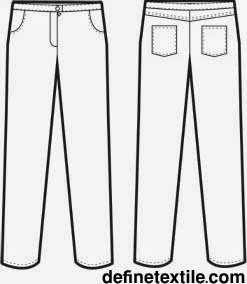
Basic Pant

Basic components of a basic pant:
  1. West band
  2. West band loop
  3. Right front part
  4. Left front part
  5. Right back part
  6. Left back part
  7. Zipper fly
  8. Crochet point
Sketch of Basic Pant:
sketch-of-basic-pant
Accessories& trimmings for a basic pant:
  1. Pocketing
  2. Fusible interlining
  3. Zipper
  4. Thread
  5. Button
  6. Label
  7. Hang tag
  8. Tag pin
  9. Price ticket
  10. Tissue paper
  11. Poly bag
  12. Ribbit
Machine required for making basic pant:
  1. Plain stitch m/c
  2. Over lock m/c
  3. Bartak  m/c
  4. Button hole m/c
  5. Button attaching m/c

Garments Production Process

There are some steps and techniques, the ready-made garments manufacturing processing are depends. The clothing creation running actions and methods included in the developing outfits for the huge of creation in company time frame for company reasons in known as outfits developing technologies.

Process sequence of Cotton Cultivation and Harvesting

Process sequence of Cotton Cultivation and Harvesting:
Seed are sown in spring
They sprout after 2-3 week
After 2-3 months of sprouting plant flowe3rs bloom
The flowers fall off after a few days and leaving cotton balls.
Seed hairs start to grow inside the balls
For 16-18 days fiber length and other parameter are achieved
For the next 22-50 days, cellulose is deposited inside the fiber
When cellulose deposition is stopped, the balls become dry and burst normally and the cotton appears as a soft wad of fine fiber
The balls are picked up manually or by machine, these picking periods continue for 1-3 months.
Finally the balls are taken for ginning to collect the fibers.

Thread Consumption of Basic Denim Pant

In textile industry there are different types of sewing machines. Each machine never needs fixed amount thread to stitch. Different types of stitch need different amount of thread. Explain below,

Fabric Package

Types of Fabric Package:
1. Open fabric roll:
         i. Most of the time fabric is supplied by wrapping over a tube which is about of 7 to 8cm dia.
        ii. The widths of the fabric roll vary from 75cm to 3m.
2. Tubular knitted fabric roll:
       i. Most of the knitted fabric is found in tubular form and they are supplied in roll from.
      ii. Tube roll usually have the same width as the garments width such as T-Shirt, Polo Shirt
3. Folded fabric roll:
     i. In this type of package fabric is wrapped over 1-2cm thick and hard board.
     ii. This type of fabric package is generally used by retail seller.
4. Folded fabric cuttled:
     i. Check fabric & knitted fabric are found in this type of package.
    ii. This type of package is used to avoid distortion of these fabrics.
5. Hanging fabric package:
     i. Velvet or expensive types of fabrics are found in this package.
    ii. Only manual spreading is possible for this type of package.

Textile Physics

In Textile Technology, physics plays a large part. The study of the structure & physical properties of fibers, yarns & fabrics forms the unified subject that is legitimately called textile physics. It is an essential part of education of any textile technologist.

Yarn Preparation

The feature of modern fabric production is intermediate packaging. The term of yarn preparation are defined by this series of operation. Before weaving two types of yarn are prepared such as weft yarn and warp yarn.  There preparation processes are different.

Weft Preparation

By means of a shuttle carrying a bobbin the filling yarn is inserted on a conventional loom. At the end the bobbin should be tapered. For that the yarn may be pulled without interruption through the eye of the shuttle as the shuttle travels from one side of the loom to the other.

Non Precision Winding

Non precision winding is one kind of packages which consists a single thread which is laid on the package. This is placed on an appreciable helix angle. For that the yarn layer gives more stability and cross one another.

Difference between Precision Winding and Non Precision Winding

The difference between Precision winding and Non Precision Winding are given below,
Precision Winding
Non Precision Winding
1. Number of coils remains constant from the first layer up to the full diameter of package.
1. Number of coils per traverse of yarn guide decrease with increase in package diameter.
2. No air gaps.
2. Air gaps are found here.
3. Winding angle is 90º or near 90º.
3. Winding angle is less than 80º.
4. Bobbin can be wound by one or more yarn.
4. Bobbin can be wound by only one yarn.
5. Less stable package.
5. More stable package.
6. Flanged bobbin is needed.
6. Flanged bobbin is not needed.
7. Yarn tension is relatively more at the time of winding.
7. Yarn tension is relatively less at the time of winding.
8. Yarn package density is more.
8. Yarn density is less in the package.
9. Yarn coil is arranged in the parallel or near parallel.
9. Yarn coil is arranged in traversal.
10. Yarn withdrawal from the package takes more time and it is relatively difficult.
10. Yarn withdrawal from the package takes less time and it is comparatively difficult.

Batch Plan


Production planning for dyeing is called Batch Plan. According to the batch number, color, width, style and construction the batch plan is made. For easy understand, this section gives some ‘T’ cards. ‘T’ cards are serialized according to the priority of delivery. The batches and ‘T’ cards are also serialized as to dye light shade at first and lastly the dark shades, since faulty shade and can be converted to dark color later.

Pigment Wash

Generally Pigment wash is doing on pigment dyed or printed garments by using pigment washing technique. The following reasons are required for pigment wash.
1.     To fading affect or old looking affect on garment and also seam abrasion.
2.     Feeling soft when wear the garments.
3.     To achieve the buyer washing standard.
4.     To increase the color fastness.
5.     And also to increase the rubbing.

Pattern

Pattern is a hard paper on which different component of garments of a particular style are sketched according to the measurement of the garments.
Grading of pattern: Pattern grading is the scaling of a pattern to a different size by incrementing important points of the pattern using an algorithm in the clothing and. According to countries, pattern grading includes USA's, EUR's, UK's, and CHN's. Generally, pattern grading adjusts for people of different ages and genders.

Polymer

Poly means many and mer means unit. Polymer means many unit of monomer.
Example: (-CH2-CH2-)n
Here n=10000-100000